Mike's Home Inspector BlogMichael Burfitt |
|
As both an entrepreneur and a holder of a bachelor’s degree in commerce, I like to view hiring an independent home inspector as a financial investment with a great return: our (low) upfront fees will usually save you significant amounts of money on home maintenance down the road. I know in my own home I have saved thousands in maintenance costs over the years with my understanding of complex building systems. Today I want to show you how, for about $40 and a decent breaker bar or torque wrench (or better yet a plumber!), you can significantly increase the life of your water heater, even more so if you live outside of an area supplied by Halifax Water that has hard water. 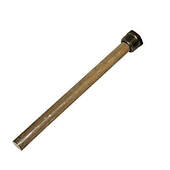 This is an anode rod, sometimes known as a sacrificial anode and is the key to extending the life of your tank. As the name implies, it sacrifices itself to take most of the corrosion away from the tank liner. Without getting into the boring science of electron flow, both magnesium and aluminum lose electrons (i.e., corrode, rust) much faster than ferrous metals such as steel, which is what most tanks are constructed of. These should be checked every year after 3 years and replaced as needed. At approximately $40, it is a lot cheaper and easier to replace than a tank: replacing ours on short notice cost us a total of $1300 just 3 days after moving into our home, not including spending our very first weekend cleaning up the mess and dealing with no hot water for the entire day.
Another way to keep your tank running well into the future is to flush it once a year: simply hook up a garden hose and turn the tap after shutting off both the power and water supply to clear impurities that have settled and cause significant rust. As I have mentioned before, a burst water tank is a deeply unpleasant experience that can be minimized with regular maintenance. Be sure to read the manuals for all your home’s equipment and appliances: there are valuable tips that can both extend the life of and improve efficiency of your home’s components. A home inspector will also look for other important safety features, such as a temperature/pressure relief valve and tube. While catastrophic tank failures are obviously rare, water heaters have an incredible amount of stored energy, and a failed tank can be shot up through the roof and into a neighbour’s yard like a rocket. Regular home maintenance can help insure you will never meet them in this way! |
Archives
July 2024
Categories
All
|
 RSS Feed

|
Inside Edge Home Inspections Ltd.
Halifax, NS 902-209-9921 [email protected] Proudly Serving the HRM & Central Nova Scotia |

|