Inside Edge
  • Home
  • Services
    • Sewer Scopes
  • Mike's Blog
  • Contact
  • Qualifications
  • Pricing
  • FAQs
  • Sample Report

Mike's Home Inspector Blog

Helpful articles from an experienced Home Inspector based in Halifax, Nova Scotia. 

Decoding An Appliance Age

8/10/2025

0 Comments

 
Being a home inspector often means developing some detective skills.

I’ve always liked how Mike Holmes would say, “I see XYZ and am going to store that in the back of my mind.” I do this on almost every inspection. Something I can’t immediately identify or explain will often become clearer as the inspection progresses. That said, there are some things that—even with modern tools and AI searches—remain surprisingly difficult. One of the biggest? Determining the age of an appliance.

You’d think such a simple question would have a straightforward answer. But ask any home inspector, and they’ll tell you: many manufacturers seem to go out of their way to make it as difficult as possible, using cryptic codes that feel like they were designed by a professional codebreaker.

Here are a few examples from well-known brands:

Lifebreath (Heat Recovery Ventilators)
Since 1995: The manufacturing date is encoded in the first six digits of the serial number.
  • Example: 081025123 = August 10, 2025 (the date I’m writing this post).
Pre-1995: The first two digits (in reverse) indicate the year, and the next two digits (not reversed) indicate the month. If yours is this old, it’s well past its expected lifespan and should be replaced.
  • Example: ABCD490812345678 = August 10, 1994.

GSW (Water Heaters)
The first two digits indicate the year, and the next two indicate the week of the year.
  • Example: 2532123456 = August 10, 2025.

Venmar (Heat Recovery Ventilators)
Residential:
The 5th and 6th characters are the year, and the 7th and 8th are the month.
  • Example: 1A2325083456 = August 10, 2025.
Commercial: The last grouping of the serial number is the manufacturing date.
  • Example: 1234567-890123-20250810 = August 10, 2025

These are some of the easier examples. Others are so cryptic I could spend literal hours researching them. In those cases, I rely on other clues—like the type of refrigerant used, the presence of a QR code, or how faded the label is—to make an educated guess. Sometimes, home inspections are less about having all the answers right away and more about knowing how to find them… even if it means a bit of detective work.

Why it Matters
Knowing the true age of appliances and systems isn’t just trivia: it can influence repair decisions, replacement planning, and even negotiation power when buying or selling a home. If an appliance is nearing the end of its lifespan, it’s better to know now than be surprised later with an unexpected breakdown. A good home inspector isn’t just looking at what’s there today: they’re helping you anticipate what might be coming tomorrow.
Picture
Look! A Unicorn! It actually has the manufacturing year listed!
0 Comments

A Look at HRV's and ERV's

9/25/2022

0 Comments

 
​I owe a lot of my skill as a home inspector to the time I spent working at NSCC (Nova Scotia Community College), where I was not only able to access high quality training but was able to see firsthand how complex modern technology helps to create safe, healthy, efficient buildings. NSCC is a leader in sustainable building practices, and I have taken plenty of courses on topics such as Heating, Air Conditioning, Pipe and Air System Design to name a few. I also learned to apply many of these principles to my own home and one project I will be working on soon is to look at replacing our HRV, possibly with a modern ERV. Modern building codes require the installation of mechanical ventilation (i.e. just exhaust fans are no longer acceptable) as modern homes are built very tight for energy saving purposes. 

What is an HRV? ERV?
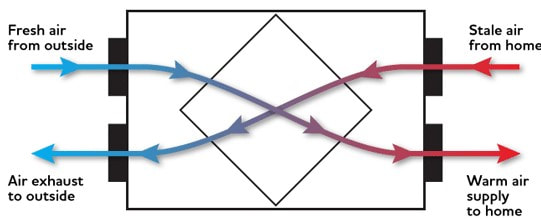
HRV stands for Heat Recovery Ventilator while ERV stands for Energy Recovery Ventilator. These two systems are very similar with the difference being that an ERV recovers both heat AND moisture. Personally, I think they should be called HMRVs (Heat & Moisture Recovery Ventilators) as this would be a better descriptor. Here is a basic diagram about how these systems work. While it appears the air mixes based on this picture, they remain completely separate with only heat (and possibly moisture) being exchanged.
Picture
So, Does This Mean a ERV is Better?
Not necessarily. While ERVs are considered a step above HRVs (and more expensive!) opinions vary on which is the right choice in Nova Scotia. While we do have humid summers, having too much humidity is not an issue for the rest of the year and heating is prioritized over cooling in our province. When considering installing a new unit, remember mechanical ventilation is a job that should be left for a qualified HVAC contractor and they can offer the best advice on what will be effective for your situation.

How Are These Units Different from an Air Exchanger?

An air exchanger does exactly what it says: exchanges air from inside to outside and replaces it with outside to inside air. This works great in theory but in reality it is rare that outside conditions are as comfortable as the ideal indoor conditions. The air outside is typically colder and bringing in constant fresh air without capturing heat from the air vented outside will lead to unnecessarily high energy bills. In short, a HRV is a step above an air exchanger with an ERV being another step above that. 

HRVs and ERVs Need Maintenance Too! 
While they are generally very reliable and are designed (and supposed) to run 24 hours a day for 20+ years, they still require regular maintenance just like any piece of HVAC equipment. The biggest faux pas (other than a home missing an HRV/ERV entirely) I see is units that have not been cleaned (often times it is clear they have NEVER been cleaned!). It is important to inspect for proper operation and clean the unit according to manufacturer's instructions, typically once a season. Are these units pricey? Absolutely, but it is a small price to pay for a clean and healthy home! 
0 Comments

    Archives

    December 2025
    November 2025
    October 2025
    September 2025
    August 2025
    July 2025
    June 2025
    May 2025
    April 2025
    March 2025
    February 2025
    January 2025
    December 2024
    November 2024
    October 2024
    September 2024
    August 2024
    July 2024
    June 2024
    May 2024
    April 2024
    March 2024
    February 2024
    January 2024
    December 2023
    November 2023
    October 2023
    September 2023
    August 2023
    July 2023
    June 2023
    May 2023
    April 2023
    March 2023
    February 2023
    January 2023
    December 2022
    November 2022
    October 2022
    September 2022
    August 2022
    July 2022
    June 2022
    May 2022
    April 2022
    March 2022
    February 2022
    January 2022
    December 2021
    November 2021
    October 2021
    September 2021
    August 2021
    July 2021
    June 2021
    May 2021
    April 2021

    Categories

    All
    AED
    Aerial Photography
    AFCI
    AI
    Air Conditioning
    Air Fresheners
    Aluminum
    Anode Rod
    Ants
    Arcs
    Arsenic
    Asbestos
    ASD
    Attic
    Autism
    Balcony
    Basement
    Brick
    Building Inspector
    Carbon Monoxide
    ChatGPT
    Children
    Chimney
    Chinese Drywall
    Christmas
    Circuit Breakers
    Cliches
    Clocks
    CO Detectors
    Communication
    Concrete
    Contractors
    Copper
    Cost
    Criticisms
    Current
    Data
    Deck
    Doors
    Drains
    Drone
    Drywall
    DWV
    Eavestroughs
    EIFS
    Electrical
    ERV
    Expert
    Exterior
    Failed Seals
    Female Inspectors
    Fiber Cement
    Fibreglass
    Fibreglass Shingles
    Fireplaces
    Fire Safety
    First Aid
    First Time Homebuyers
    Flips
    Flooding
    Flooring
    Fluoride
    Foundation
    Framing
    Fuses
    Garage
    Garage Doors
    Garage Safety
    Gfci
    Growops
    Heating
    Heat Pumps
    Hgtv
    Hoarding
    Home Inspectors
    HRV
    Humidity
    HVAC
    Ice Dams
    ICF
    Infrared
    Insulation
    Ionization
    Joe Mazza
    Kitchen
    Kitec
    Knob & Tube
    Lead
    LGBT
    Manufactured Houses
    Marijuana
    Masonry
    Meth
    Mice
    Mike Holmes
    Mineral Wool
    Mini Homes
    Misconceptions
    Mobile Homes
    Moisture
    Mold
    Newcomers
    New Inspectors
    Oil Tanks
    Open Concept
    Orangeburg
    Patina
    Pay At Closing
    Personal Decor
    Pests
    Photoelectric
    Plumbing
    Polybutylene
    Pressure
    Price
    Professionalism
    Psychrometrics
    Radon
    Rain Gutters
    Real Estate Agents
    Regulations
    Remodelling
    Renovations
    Resistance
    Ridge Vent
    Roofing
    Rust
    Safety
    Scams
    Septic
    Sewer
    Sewer Scopes
    Sheds
    Shipping Containers
    Siding
    Smoke Detectors
    Smoking
    Soffits
    Staircases
    Steel
    Stove
    Structure
    Stucco
    Sump Pump
    Swamp Coolers
    Temperature
    Termites
    Trailer Parks
    Trees
    Value
    Ventilation
    Ventless Heaters
    Vinyl
    Voltage
    Walls
    Wasps
    Water Heater
    Water Testing
    WDOs
    Windows
    Wiring
    Wood
    Wood Rot

    RSS Feed

Picture
Inside Edge Home Inspections Ltd. 
Halifax, NS
902-209-9921
[email protected]
Proudly Serving the HRM & Central Nova Scotia
Picture
  • Home
  • Services
    • Sewer Scopes
  • Mike's Blog
  • Contact
  • Qualifications
  • Pricing
  • FAQs
  • Sample Report